You have just signed the lease for that walk-up apartment near the Old Market. The landlord is friendly, the deposit is paid, and your second-hand couch is scheduled for delivery. You feel a sense of stability, a small victory in this economy.
But here is a question you are not asking yourself: what happens to everything you own if a pipe bursts in the unit above yours at 2 AM? Or if the teenager in 3B falls asleep while charging their scooter?
Many renters in Omaha assume the landlord’s policy has them covered. That is a dangerous guess.
Let me be clear as someone who has processed claims for fifteen years. Your landlord’s insurance protects the building’s walls, the roof, and the hallway light fixtures. It does not touch your laptop, your grandfather’s watch, or the clothes in your closet. If a fire starts from faulty wiring inside your unit, you are looking at a total loss. The landlord rebuilds the kitchen. You, on the other hand, start from zero.
This is where renters insurance enters the picture, but not in the way the glossy ads present it. Most people think of it as a simple “what if” policy. In reality, it is a financial survival tool with two distinct layers.
The first layer is personal property coverage. This pays to replace your things. However, the key detail that agents often skip is the difference between Actual Cash Value and Replacement Cost. Actual Cash Value sounds fair until you realize it means you get the depreciated value of your three-year-old television. You paid eight hundred dollars. They give you maybe one hundred and fifty. Replacement Cost gives you enough to buy a new, similar television. The difference is the difference between frustration and relief. In a city like Omaha, where winter storms and summer thunderstorms are routine, choose Replacement Cost. Do not let anyone sell you the cheaper version.
The second layer is liability protection. This is the quiet hero. Imagine you leave the balcony door open during a freezing night. A pipe freezes, bursts, and water damages the unit below and the neighbor’s antique furniture. Without liability coverage, that neighbor’s insurance company will come after you directly. You could be looking at a judgment of twenty, thirty,or even fifty thousand dollars. Renters insurance typically includes one hundred thousand dollars in liability, and it moves first. It handles the legal defense and the settlement. For a cost that is often less than your monthly coffee routine, that is a staggering amount of protection.
But there is a catch. And this is where the industry gets tricky.

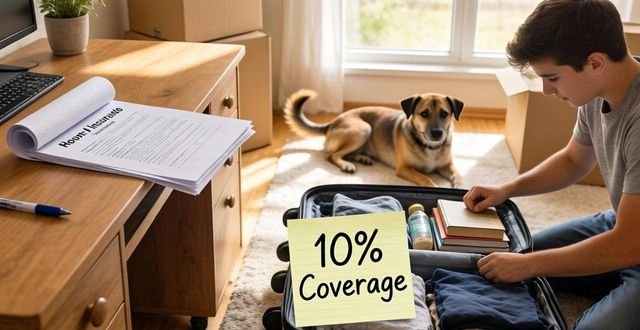
Many people rely on their parents’ homeowners policy or a roommate’s plan. Here is the truth: a homeowners policy often limits coverage for a child’s off-campus belongings to a tiny percentage of the total, sometimes as low as ten percent. If a roommate has a policy, it covers their name, not yours. Unless you are listed as an Additional Insured, their check goes to them only. Your gaming setup and your work-from-home monitor are your responsibility. No one else’s.
Let me give you an Omaha-specific example. You live near Benson. A severe storm knocks out power for three days. Your deep freezer full of meal-prepped food thaws and spoils. Do you have coverage for that? Most standard policies include food spoilage as part of the personal property limit, but the deductible matters. A five-hundred-dollar deductible on a two-hundred-dollar food loss gives you nothing. This is why I always ask my clients to run a simple calculation: total the value of what you would need to buy tomorrow if you lost everything today. Clothes. Phone. Laptop. Bedding. Dishes. Medicine. For most young professionals, that number lands between ten and fifteen thousand dollars. The right policy for Omaha is one with a low deductible, around two hundred fifty dollars, and Replacement Cost coverage. The monthly difference is rarely more than the price of one sandwich at Block 16.
Another mistake I see constantly is skipping the “Loss of Use” coverage. This is not a luxury. If a fire or a severe water leak makes your apartment uninhabitable, where do you go? Loss of Use pays for a hotel, meals, and even laundry while your unit is being repaired. Without it, you are sleeping on a friend’s inflatable mattress. With it, you maintain some dignity during a crisis. Given the age of many apartment buildings in midtown Omaha, this is not a hypothetical.
Now, what about the specific carriers available to you? Carrier A might offer a lower premium but apply a strict sublimit for electronics. Carrier B might have a higher premium but no sublimit and a broader definition of “water damage.” The difference often comes down to the Elimination Period, which is the waiting time before certain coverages kick in. A shorter period costs slightly more. In my experience, spending those extra two dollars a month to lower the waiting time from forty-eight to twenty-four hours is worth it. You are not betting against a disaster. You are buying time to breathe.
You might be thinking, “I will just add this to my auto policy for a discount.” That is a valid instinct. But the bundle discount is often small. The real question is the quality of the renters policy itself. Some auto carriers treat renters insurance as an afterthought, with slow claims handling and automated phone trees. A dedicated carrier that specializes in renters often provides a faster, human-led process. Speed matters when you are standing in a parking lot watching your belongings get carried out in soggy boxes.
So, what is your actual next step? Do not open a browser and click the first sponsored result. Instead, do this: walk through your apartment with your phone camera. Open each drawer. Record every item of value, including the model numbers of electronics. Get a rough total. Then, send that number to an independent agent. An independent agent (like me) quotes multiple carriers at once and explains the trade-offs. We can tell you which company in Nebraska has a reputation for paying claims fairly and which one fights every water damage claim with a lawyers-first strategy.
Here is the bottom line for Omaha. Your lease is a promise to pay rent. Renters insurance is a promise to protect your ability to keep living your life after an interruption. The cost is insignificant. The consequence of going without is financially devastating.
Do not wait until the morning after the fire. Call an independent agent today, compare two or three actual policies, and buy the one with Replacement Cost and a low deductible. Then, stop worrying. You have more important things to do, like finding parking in the Old Market on a Saturday night.