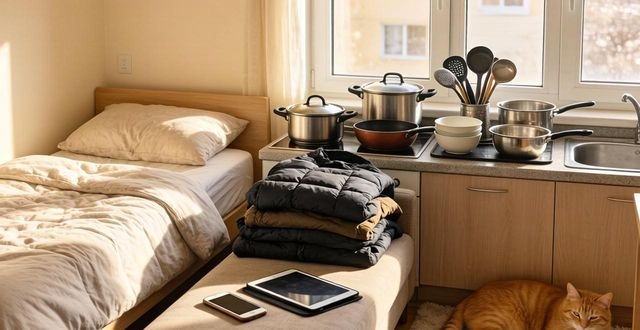
You’re coming home after a long weekend away. The drive was smooth, but as you turn onto your street, you see it. A tree from the neighbor’s yard is now resting on the roof of your apartment building. Your unit is on the third floor. Your stomach drops. The laptop on your desk holds your freelance portfolio. The vintage guitar in the corner was your grandfather’s. That new sofa you just finished paying off? It’s directly under where the water is likely pouring in. You fumble for your phone, your mind racing. Does my renters insurance cover this? If your first instinct was to call your landlord, you’re already thinking about this wrong. Here is where things get tricky.
Landlords insure the building. The structure. The bricks, the roof, the shared hallways. You insure your life inside it. Your stuff. Your liability. Your peace of mind. Storm damage coverage within a standard renters insurance policy isn’t a separate line item; it’s woven into the fabric of your personal property and loss of use protections. But the devil, as they always say, is in the details—details most people gloss over until it’s too late.
Let’s break down the consequences, not just the definitions. When a named windstorm, tornado, or hail storm rips through, your policy typically responds in two main ways:
Your Personal Property: This is the coverage for your belongings. Clothes, electronics, furniture, kitchenware. It’s not just about reimbursement; it’s about how you get reimbursed. You have a choice: Actual Cash Value (ACV) or Replacement Cost Value (RCV). ACV pays you what your five-year-old TV is worth today, after depreciation. That might be $150. RCV pays you what it costs to buy a new, comparable TV today. That could be $800. The premium difference is often less than a few coffees a month, but the payout difference is life-altering after a total loss. Which one do you have? If you don’t know, you’re rolling the dice.
Loss of Use / Additional Living Expenses (ALE): This is where true financial security kicks in. If storm damage makes your apartment uninhabitable, ALE covers the extra costs you incur to maintain your normal standard of living. Hotel bills, restaurant meals (since you can’t cook), even extra gas mileage. Most policies cover this for a set period or up to a percentage of your personal property limit. Think about hotel rates during a regional disaster—they spike. Will your coverage limit be enough?
Now, let’s talk about the catch. The exclusions. The fine print that turns a “yes, you’re covered” into a “sorry, not for this.”
Flooding is the grand canyon of exclusions. A storm surge, overflowing rivers, or even heavy rain seeping in from the ground is almost universally not covered by a standard renters policy. You need a separate flood insurance policy, often through the NFIP. If you’re on the first floor or in a flood zone, this isn’t optional; it’s essential.
The “Named Storm” Deductible. In many coastal states, your policy might have a special, often higher, deductible that applies only to damage from named hurricanes or tropical storms. Instead of your standard $500 or $1000 deductible, you might have to pay 2%, 5%, or even 10% of your dwelling’s insured value out of pocket before coverage kicks in. For a $300,000 building, a 5% deductible is $15,000. Do you have that saved?
Here are the two most expensive mistakes I see renters make every year:

1. “I don’t own enough to bother.” You do. Add up your clothing, your bed, your kitchen appliances, your books, your electronics. Most people are shocked to find they own $20,000, $30,000, or more in personal property. Could you replace it all from your savings tomorrow?
2. “I’ll just rely on photos for my inventory.” After a major storm, when you’re stressed and displaced, trying to list every single item you owned from memory is a nightmare. You will forget things. Use your phone right now. Do a video walk-through of your apartment, opening drawers and closets, narrating as you go. Store that video in the cloud. This single act will make the claims process infinitely smoother.
So,what’s your next move? Don’t wait for the weather forecast to turn grim.
Pull out your policy. Not the declaration page, the full policy. Find the sections on “Perils Insured Against” and “Exclusions.” Look for the words “windstorm,” “hail,” and “flood.”
Call your agent, not a 1-800 number. Ask two pointed questions: “Do I have ACV or RCV on my contents?” and “What is my deductible for a named windstorm?”
Value your belongings accurately. Use an online home inventory tool. Underinsuring to save $10 a month is a catastrophic financial gamble.
Consider an umbrella. Not for the rain, but for liability. If that tree from your neighbor’s yard was rotten and you’d mentioned it to them, their insurer might come after you. Personal liability coverage in your renters policy is your first defense.
The storm will pass. The damage will be assessed. The real question is whether you’ll be having a stressful conversation with an adjuster or a devastating conversation with your bank account. Your renters insurance isn’t about the stuff; it’s about the aftermath. It’s the guarantee that after the worst day, you have the means to start the next one. Don’t let the fine print be the storm you didn’t see coming.